At Namrata Shah Jewellery we believe that choosing the right pearl is essential, as each type carries its unique beauty and significance. To help you make the perfect choice, we’ve provided detailed insights for you to understand pearls better.
Pearls form when an irritant, such as a grain of sand, gets inside an oyster's shell. The oyster secretes layers of nacre around the irritant, eventually forming a pearl.
Pearls are organic gemstones and are unique among gemstones because they are created by living organisms, primarily oysters and some mollusks.
Natural Pearls and Cultured Pearls differ primarily in their formation process. Both types are REAL PEARLS but differ in origin and availability.
| Feature | Natural Pearls | Cultured Pearls |
|---|---|---|
| Formation | Form naturally without human intervention in wild oysters or mollusks. | Form with human assistance by inserting a nucleus into oysters or mollusks. |
| Rarity | Extremely rare, as they occur spontaneously in nature. | More common and widely available due to controlled cultivation. |
| Cost | Highly expensive due to their rarity and uniqueness. | Generally more affordable as they are produced in larger quantities. |
| Appearance | Often irregular in shape and size, with unique characteristics. | More uniform in shape, size, and color due to controlled growth conditions. |
| Production Time | Takes several years to form naturally in the wild. | Forms faster, usually within 6 months to a few years, depending on the type of cultured pearl. |
| Source | Found in natural water bodies like oceans, seas, and rivers. | Cultivated in pearl farms, in either saltwater or freshwater. |
| Quality Consistency | Quality varies greatly due to unpredictable natural conditions. | Quality is more consistent as the process is managed and monitored. |
Freshwater Pearls: Freshwater pearls are lustrous gems cultivated in freshwater lakes and rivers, known for their diverse shapes, sizes, and natural colors. They are prized for their affordability and versatility, making them perfect for everyday jewellery.
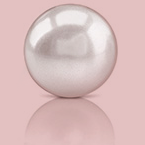
Saltwater Pearls: Saltwater pearls are exquisite gems cultivated in ocean waters, celebrated for their superior luster, round shape, and classic appeal. These pearls, including Akoya, Tahitian, and South Sea varieties, are highly valued for their beauty and elegance.

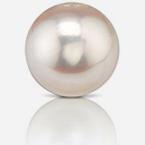
Akoya Pearls:Akoya pearls are renowned for their exceptional luster and near-perfect round shape, primarily cultivated in Japan. Akoya are saltwater pearls ranging between 2mm to 10mm. They are available in white, cream, and subtle shades of pink or silver. Akoya pearls are known for their mirror-like shine and are a classic choice for elegant jewellery.
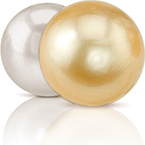
South Sea Pearls: A South Sea pearl is a highly prized gem known for its large size, rich luster, and exceptional quality. These pearls are primarily cultured in the warm waters of the South Sea, between northern Australia and Southeast Asia.
South Sea Pearls range in size from 9mm to 20mm, making them some of the largest pearls available. Their rarity and exquisite beauty make them a favorite for high-end jewelry. South Sea pearls are renowned for their thick nacre, which gives them a deep, satiny luster, and they come in a range of natural colors, including white, silver, and gold.
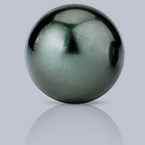
Tahitian Pearls: Tahitian pearls, also known as Black South Sea Pearls or Black Pearls, are among the most exotic and highly valued pearls in the world cultivated in the pristine waters of the Tahiti Sea in French Polynesia, these pearls are celebrated for their natural dark colors, including deep black, rich grey, and captivating shades of green, blue, and purple. Tahiti pearls are produced by the black-lipped oyster also called as Pinctada margaritifera oyster. Tahitian pearls are prized for their exceptional luster, impressive size, and unique overtones, making them a true symbol of luxury and elegance.
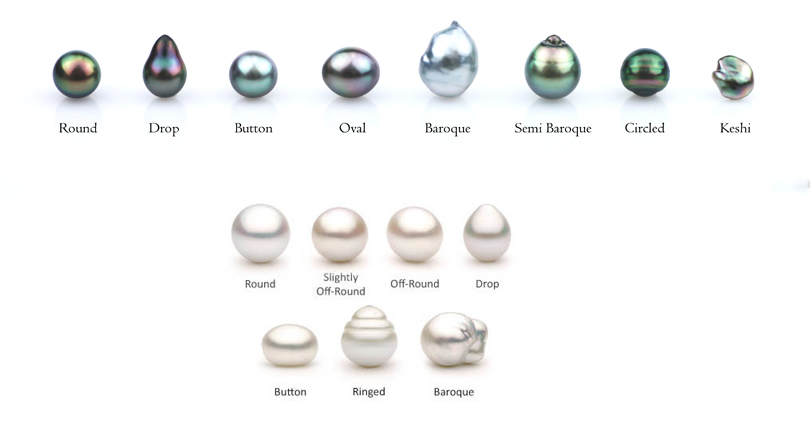
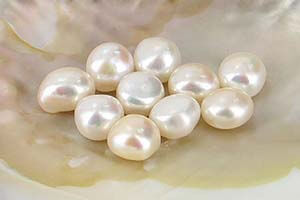
Baroque Pearls: Baroques are irregularly shaped, non-spherical pearls, known for their unique and organic forms. Unlike traditional round pearls, baroque pearls can have varied shapes like ovals, drops, or abstract forms, making each one distinct,and often used in statement jewelry for a more artistic and natural look.
Edison Pearls: Edison pearl?
Edison pearls are large, high-quality freshwater pearls known for their impressive size (11mm-16mm), brilliant luster, and diverse natural colors. Including white, pink, lavender, gold, and dark tones.
Edison pearls are bead nucleated, similar to saltwater pearls, which allows them to grow larger and rounder. With a cultivation process of 3-5 years, these pearls offer excellent durability due to their thick nacre. Edison pearls are more affordable than saltwater varieties like Tahitian or South Sea pearls, making them a popular choice for those seeking beauty, uniqueness, and value.

A pearl undertone is a tint or hue that a pearl can give off when light reflects off of it . Pearl undertone is the soft hint of color that becomes visible as light reflects off the pearl’s surface, enhancing its overall beauty and uniqueness.
Undertones can range from warm shades like rose and cream to cooler hues like silver and lavender
Freshwater pearls captivate with their subtle undertones, ranging from soft pinks and creamy whites to shimmering lavenders and silvery hues. These natural variations add depth and uniqueness to each pearl, showcasing their enduring elegance.

Pearl overtones refer to the subtle secondary colors that shimmer over a pearl’s primary body color, enhancing its beauty and individuality.
Pearl overtones play a significant role in complementing different skin tones, enhancing the natural beauty of both the wearer and the jewelry. The soft hues of pearls, from cool silvers to warm golden tones, can be chosen to create harmony or contrast with various skin tones.
Pearl overtones create a soft, luminous effect on fair skin tones, enhancing their natural brightness. The gentle interplay of light and color adds an air of elegance, making the pearls appear radiant and delicate.
On medium skin tones, pearl overtones bring out the natural warmth and depth of the complexion. The subtle hues blend seamlessly, adding a refined glow that accentuates the skin’s natural richness.
Pearl overtones stand out beautifully against dark skin tones, creating a striking visual effect. The contrast enhances the vibrancy of the pearls while adding dimension and depth to the overall look.
Selecting the perfect length for your pearl necklace depends on the occasion, your personal style, and your neckline. Here’s a quick guide:
This sits snugly around the neck and pairs beautifully with open necklines or off-shoulder outfits for a classic, elegant look.
The most versatile length, it rests just below the collarbone and complements almost any neckline, from casual to formal.
Ideal for business or semi-formal occasions, this length works well with high necklines or layered styles.
Perfect for adding drama, this length can be worn as a single strand for evening wear or doubled up for a chic layered look.
A bold statement piece that can be styled in various ways, including knotting or layering, suitable for special occasions.